Kaio was the kind of place that doesn’t make it onto maps: a hamlet of a couple of dozen households in the hills near Kamo, in the north of Okayama Prefecture, about 111 people in all. In the spring of 1938 it had no idea it was about to become the scene of one of the worst killings by a single person in Japanese history.
In the small hours of 21 May, over roughly an hour and a half, a 21-year-old resident named Mutsuo Toi killed 30 of his neighbours. Sources give slightly different totals, between 29 and 31, depending on how later deaths are counted. Three more people were seriously injured. Before dawn, Toi climbed a nearby mountain and took his own life.
Who he was
Toi had lost both parents to tuberculosis as a small child and was raised by his grandmother. He was considered bright at school, but he didn’t go on to higher education and spent much of his youth at home. In 1937 he was diagnosed with tuberculosis himself, and that diagnosis got him rejected from military conscription, a serious source of shame for a young man in Japan at the time.
In a village that small, the illness also cost him socially. People were afraid of catching it, and some of the relationships he had in the hamlet ended. He grew withdrawn and resentful, and over many months he began collecting weapons.
It’s easy to read that history and look for a single cause. There wasn’t one. Plenty of people faced illness and rejection in rural Japan in the 1930s, and they didn’t do what Toi did.
The night
On the evening of 20 May, Toi cut the electricity to the village. He killed his grandmother first. Then, carrying a rifle, a Japanese sword and other weapons, with lights strapped to his head, he went from house to house in the dark.
That image, the young man with torches fixed to his head, is what most people remember about the case, and it went on to haunt Japanese fiction for decades. We’ll leave the rest of the night where it belongs: with the people who lived through it.

Afterwards
Toi left notes explaining himself before he died, which is part of why so much is known about his reasoning, and why that reasoning has been picked over ever since. With the killer dead, there was no trial.
For the survivors, there was nothing to do but live with it. Many families eventually left. For years the case was something people in the area simply did not discuss, and Japan was soon at war, with other things to talk about. Today only a handful of people live in the hamlet. Toi’s family home was demolished in 2015.
From massacre to legend
The case didn’t stay buried. In 1949 the mystery writer Seishi Yokomizo used it as the seed for The Village of Eight Graves (Yatsuhaka-mura), one of his best-known Kindaichi novels, with a flashback to a massacre by a man with torches on his head. The book has been adapted for film and television many times. A more direct retelling, the 1983 film Ushimitsu no Mura, released in English as Village of Doom, is still hard to watch.
So the night in Kaio became, in a sense, a ghost story: a shape Japanese horror keeps returning to, of a quiet rural village with something terrible in its past.
Why we paired it with the Gashadokuro
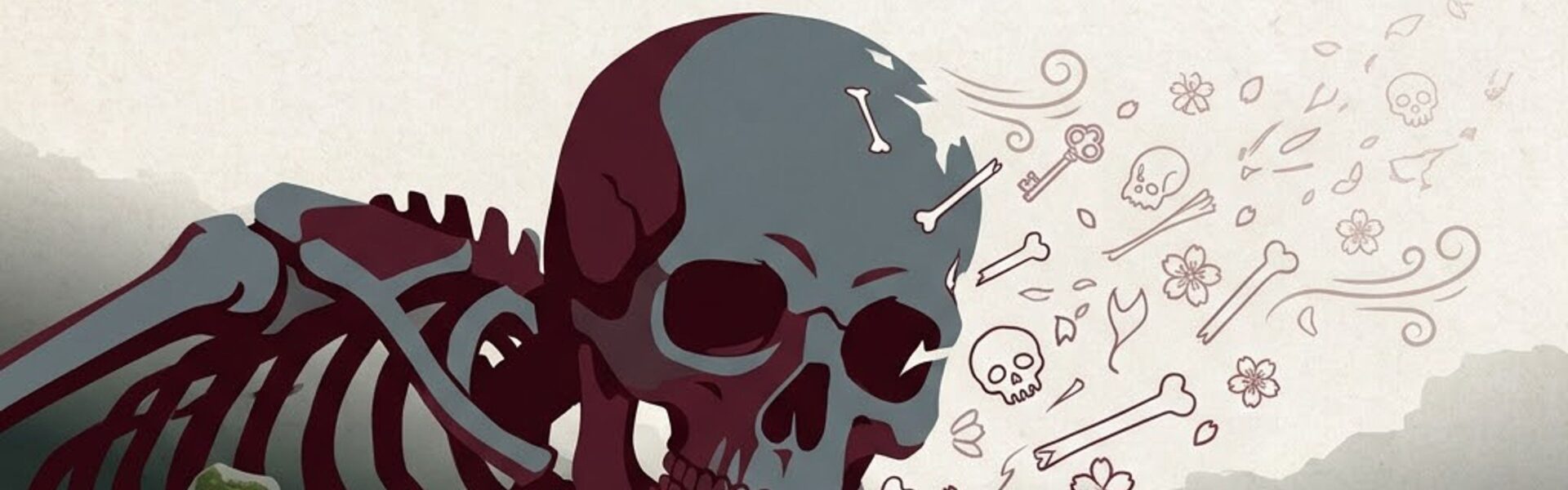
In our episode, the case sits alongside the Gashadokuro, the giant skeleton of Japanese folklore said to form from the bones of people who died without burial or remembrance, and to roam at night looking for the living. It’s a yōkai born from collective, unacknowledged death. That felt like the right companion for a village where so many people died in one night, and where for years afterwards nobody would speak of it.
You’ll find more pairings like this in our guides to Japanese true crime and Japanese urban legends and yōkai.
Sources: Tsuyama massacre (Wikipedia); The Village of Eight Graves (Wikipedia).