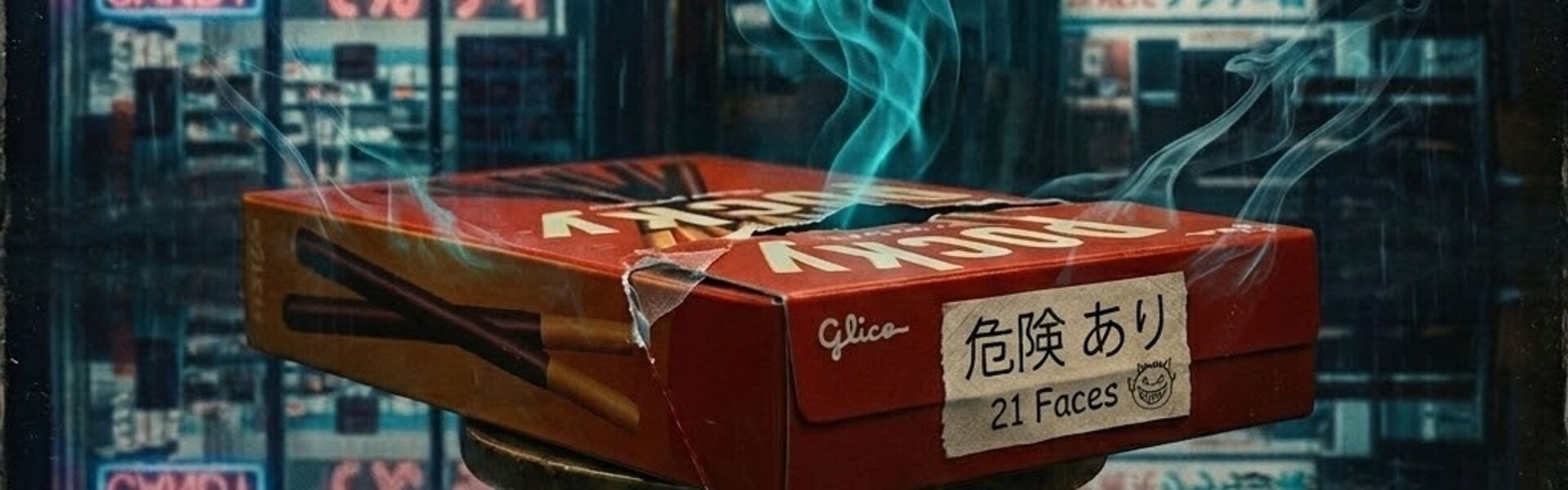
Imagine walking into a convenience store in 1984 and finding a sweet on the shelf with a label stuck to it: Danger: contains poison.
For more than a year, that was a real possibility in western Japan. A group calling itself Kaijin 21-Mensou, the Monster with 21 Faces, kidnapped the head of one of the country’s biggest confectionery companies, set fire to cars, threatened to poison food, ran police in circles and wrote mocking letters to the press. Then it vanished. Nobody has ever been caught.
The name was borrowed from fiction: Kaijin Nijū-Mensō is the master-of-disguise villain in Edogawa Rampo’s detective stories, the nemesis of Rampo’s sleuth Kogoro Akechi. Whoever chose it had a sense of theatre, and they used it.
How it unfolded
- 18 March 1984. Armed men break into the Nishinomiya home of Katsuhisa Ezaki, president of Ezaki Glico, the company behind Pocky. They take him away and demand a ransom of 1 billion yen and 100 kg of gold.
- 21 March. Ezaki escapes on his own from a warehouse in Ibaraki, Osaka, where he’d been held. No ransom is ever paid.
- April. Cars are set on fire at Glico’s headquarters, and threatening letters keep coming.
- May. The group announces that it has laced Glico products with cyanide. Glico pulls its products from shelves across the country, at enormous cost.
- 26 June. A letter to the media declares, more or less, that the group forgives Glico. The attention moves on.
- Later in 1984. Other food companies, including Morinaga, Marudai Ham, House Foods and Fujiya, receive demands. Packets marked as poisoned turn up in shops.
- 12 August 1985. The last message arrives, and the Monster goes silent for good.
The man with fox eyes
The case’s most famous image is a police sketch. At ransom drops that the group arranged and then abandoned, officers noticed the same man, with narrow, slanted eyes. The press nicknamed him the kitsune-me no otoko, the fox-eyed man. Police released a composite of him in early 1985, and it was everywhere.
He was never identified. At least once, plain-clothes officers had him in sight and held back, hoping he’d lead them to the rest of the group. He didn’t. On another occasion, officers in Shiga Prefecture came across a suspicious car, gave chase and lost that too.
Letters to the press
What made the case feel so personal to the public were the letters. The group wrote dozens of them, to newspapers and to police, in a mocking, chatty Kansai dialect, teasing detectives about their mistakes. It was a strange mix of menace and showmanship, and it turned a crime into a national drama.
That drama had a real cost. In August 1985, after the failed chase in his prefecture, the Shiga police superintendent took his own life. Days later the Monster sent its final letter, which mentioned his death and announced that it was finished.
The theories
Without a confession, the case has attracted every kind of explanation. Some people point to stock manipulation, since the companies’ share prices swung dramatically and someone could have profited quietly. Others suspect organised crime, a grudge against the companies, or a group with links to corporate extortion that was common in Japan at the time. None of these has ever been proven.
The statutes of limitation ran out: in 1994 for the kidnapping, and in February 2000 for the last of the attempted murder charges. Whoever the Monster was, they can no longer be prosecuted in Japan.
Why it still lingers
Part of the fascination is that it’s a crime almost without victims in the usual sense. Nobody is confirmed to have died from the poisonings. And yet it frightened a whole country, through the simplest of objects: a box of sweets in a shop. It’s the sort of fear that the best horror is built on.
If unsolved Japanese cases are your thing, read our case guide to Japanese true crime, which includes the Setagaya family murders, still open after a quarter of a century.
Sources: Glico Morinaga case (Wikipedia).